Scaling AI — Supercharging Execution
Why scaling AI is becoming a coordination challenge
Key takeaways
- AI is transforming supply chains into tightly coordinated systems
- Bottlenecks are no longer isolated but accumulate across multiple layers
- Execution discipline is becoming the key differentiator in scaling AI
The first phase of AI created momentum as model performance improved rapidly, and scaling appeared constrained mainly by capital.
That phase is ending.
As AI moves into deployment, the challenge is no longer just expanding capacity. It is ensuring that different parts of the system move together without delay. This is forcing a fundamental redesign of the supply chain.
From linear supply chains to coordinated systems
Traditional supply chains scaled in stages. When demand increases, production could be expanded at individual points, such as fabrication or assembly, without disrupting the entire system.
AI breaks that model.
Wamsi Mohan, BofA Global Research's IT Hardware and Technology Supply Chain Analyst, described this shift as:
“The AI cycle is forcing a full system reset where workflows, architectures and operations are being redesigned simultaneously.”
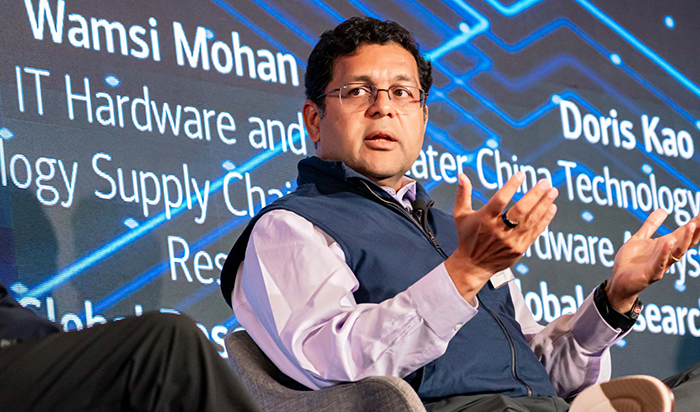
Wamsi Mohan, BofA Global Research, discusses AI supply chain coordination
As AI systems become more complex, each layer becomes dependent on the others. Compute depends on memory, memory increases power demands, and power constraints influence how data centers are designed and deployed. Packaging capacity, in turn, determines how quickly new architectures can be brought online.
Why pressure points are compounding
A common assumption is that bottlenecks shift across the system over time. In practice, AI bottlenecks are accumulating.
Robert Cheng, Head of Taiwan Research and Head of Asia Tech Hardware Research at BofA Global Research, highlighted the shift clearly:
“This cycle places greater demands on hardware than previous eras, with higher price points, tighter tolerances and new architectures all emerging at once.”
This concentration of complexity means that pressure points appear simultaneously across multiple layers. Packaging limitations, memory integration, power availability and system integration challenges all interact with each other.
Adding capacity in one area does not eliminate these limits. It often transfers pressure elsewhere in the system.
Increasing execution risk
As AI systems become more complex, the cost of execution increases. Haas Liu, Semiconductor Analyst at BofA Global Research, noted:
“AI -related data centers have rapidly increased their share of semiconductor consumption, overtaking smartphones as the dominant source of demand.”
This concentration of demand raises capital requirements and increases reliance on fewer, more specialized platforms. As a result, errors in forecasting, system cohesion or timing have a more significant impact than in previous cycles.
In this environment, advantage is no longer defined by capacity alone. It is defined by how well different parts of the system are aligned.
Regions with dense ecosystems can coordinate design, manufacturing and integration more efficiently. This reduces iteration time and improves reliability when systems evolve.
Robert Cheng has described the supply chain as the backbone of global AI, not because of individual components, but because of how those components are connected.
The implication is straightforward: execution quality is becoming the primary differentiator.
Alignment driving performance
Resilience in previous cycles was largely about diversification. In AI, it is increasingly about alignment. Simon Woo, Head of Korea Research noted:
“AI systems grow more complex, and the memory and infrastructure supporting them cannot be treated as interchangeable inputs.”
This reflects a shift from interchangeable components to tightly integrated systems. Substitution is more difficult, and dependencies are deeper across suppliers. The AI supply chain is no longer a collection of independent processes. It is a coordinated system that must function as a whole. Winnie Wu, Head of APAC Equity Strategy at BofA Global Research, described AI as “A layered upgrade across infrastructure, hardware, models, and applications.”
Each layer faces different constraints, and bottlenecks in one layer can slow overall progress. This reinforces a key shift: scaling AI is not just about speed, but about consistency and alignment.
Key questions shaping the AI buildout
What factors are shaping how AI scales?
System coordination across packaging, memory, infrastructure and integration.
Why is capacity alone no longer enough?
Because scaling requires synchronization across multiple layers. Surplus in one area cannot offset shortages in another.
Can supply chains diversify away from Asia?
Diversification will increase at the margins, but core integration capabilities remain deeply embedded in the region.
More for you

Asia and the AI hardware era
AI is running into physical limits. The next winners will be those that can scale beyond them.

From data centers to the real world
AI is moving beyond the data center and into the physical world, reshaping industries from mobility to robotics and automation.