The ERP transformation trap: Why payables automation shouldn’t wait
There are many common misconceptions around payables automation, but the truth is simple: The sooner you automate payables, the sooner you can realize value.

Mike Holly | Director, Senior Product Sales Specialist, Bank of America

Matthew Gaddis | Director, Senior Product Sales Specialist, Bank of America
6 minute read
Key takeaways
- Many companies upgrade their ERP systems first, then tackle payables automation, but doing both together can save time and effort.
- Waiting to upgrade payables can result in avoidable costs due to ongoing manual processes and increased fraud risks.
- Implementing a comprehensive payables solution can quickly ramp up fraud protection and improve operational efficiency.
ERP transformation has become one of the most common reasons organizations delay modernizing how they move money. However, it can be the ideal moment to modernize payments, as tackling both initiatives in parallel can deliver significant benefits.
Payments don’t pause during ERP transformation, but too often, modernization efforts do. Payments and ERP systems operate at different layers. Treating them as dependent creates unnecessary delays and risk. In fact, operational risk, inefficiency and complexity often increase during this period. While ERP upgrades are critical, they are frequently — and incorrectly — viewed as a prerequisite for improving payment processes.
In reality, ERP transformation and payments modernization solve distinct problems. ERP systems record financial data and obligations, while payments modernization focuses on execution, control and scale. Sequencing them — as if one must wait for the other — delays value, prolongs risk exposure and adds complexity.
Prioritizing a high-impact initiative
From cloud ERPs to AI, technology options are expanding rapidly and making transformation more complex. Modernizing payables independent of — or alongside — ERP initiatives helps organizations manage this complexity by improving payment execution, strengthening controls and reducing reliance on manual processes.
ERP systems are not designed to optimize how payments are executed or secured. Payables automation addresses this gap directly. It streamlines workflows, enhances visibility and reduces operational friction. This can play a key role in mitigating fraud and, in some cases, transform payables into a source of financial value through rebates and working capital optimization.
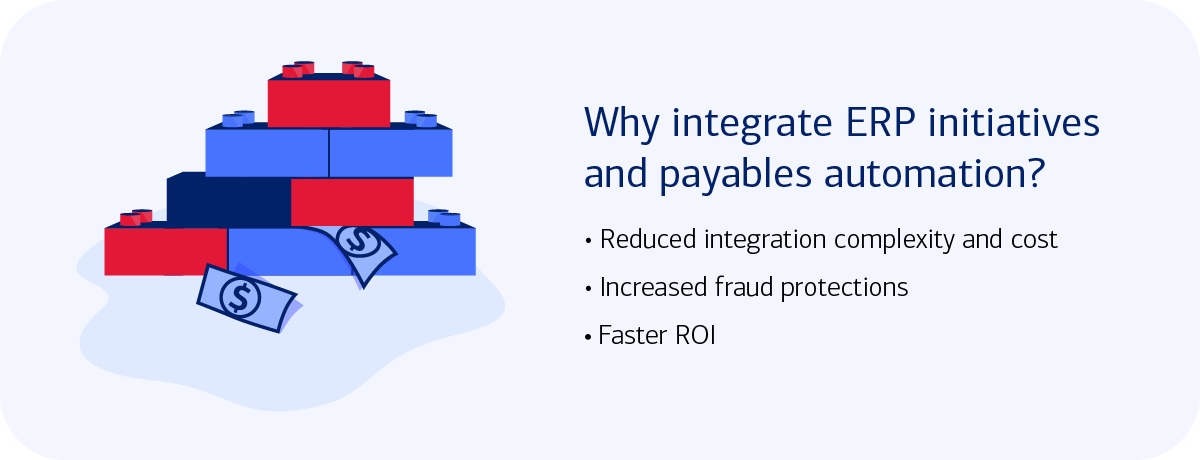
Timing is another advantage. Payables automation projects can often be completed in four to six months, while ERP transformations typically take 18 to 24 months. Running these initiatives in advance or in parallel allows organizations to realize benefits sooner, including increased electronic payment adoption, reduced processing costs and improved cash flow visibility.
Why do organizations delay?
Despite the advantages, many organizations defer payables modernization. Because ERPs are foundational in supporting finance, procurement, payroll and more, leaders often prioritize them exclusively, especially if payments appear to be functioning adequately.
Company size can influence this decision. Mid-sized organizations are more likely to delay due to perceived resource constraints and a desire to limit change during a high-visibility ERP project. Larger enterprises tend to run initiatives in parallel, recognizing that payment risk continues throughout multiyear transformations. However, they face their own challenges, including complex governance, multiple stakeholders and fragmented ERP landscapes.
A common assumption also drives delays: that payables automation must follow ERP completion. While seemingly intuitive, this view is outdated. Modern bank-led payment solutions such as comprehensive payables are designed to integrate with multiple ERP systems and remain stable as underlying platforms evolve. This flexibility enables organizations to move forward independently of ERP timelines.
In fact, running both initiatives together can reduce disruption. ERP transformations already involve reviewing processes, engaging suppliers and communicating change. Extending that effort to payments can increase efficiency and avoid duplicative work later.
The risks of waiting
Across organizations, a consistent pattern is emerging: Companies that delay payables automation during ERP transformation almost always revisit it later, often under greater urgency, higher cost and increased risk.
Waiting is not a neutral decision. It extends inefficiencies, fraud exposure and missed financial opportunity across the duration of a multiyear ERP program. Manual processes, fragmented workflows and inconsistent supplier onboarding remain in place, driving unnecessary costs and limiting visibility into working capital. Organizations also continue to manage and validate sensitive banking data across multiple systems, increasing operational burden and risk.
Fraud exposure is a particular concern. Periods of transformation often introduce process changes and control gaps, making organizations more vulnerable to errors and attacks. Maintaining outdated payment processes during this time can significantly elevate risk.
Being held back by inefficiencies means not having full insight into working capital and missing opportunities to cut costs or even to grow.
How bank-led solutions can help
Bank-led solutions such as comprehensive payables are designed to complement ERP environments while delivering operational and financial benefits. These solutions strengthen fraud protection, improve efficiency and support working capital goals while also offering potential revenue-sharing opportunities. They can allow organizations to modernize payments without waiting for ERP completion.
Key advantages include:
- Simplified supplier relationships: Centralized payments allow suppliers to receive standardized remittance data in a single file, making reconciliation easier and reducing administrative burden, especially for organizations with large supplier networks.
- Centralized banking information management: Suppliers can update their banking details once, with changes automatically reflected across participating buyers. This reduces manual effort and significantly lowers fraud risk.
- Seamless integration: Modern payables solutions integrate with a wide range of ERP systems and platforms, ensuring compatibility without disrupting core systems.
A better approach to transformation
Progress does not have to be sequential, and in many cases, it shouldn’t be.
ERP systems are foundational, so it’s natural they receive significant attention during transformation. However, organizations that treat payables modernization as a parallel priority — not a subsequent step — tend to achieve better outcomes. They reduce risk earlier, capture financial benefits sooner and simplify their overall transformation journey.
In today’s environment, finance leaders are expected to deliver both operational stability and measurable results. Against this backdrop, the question is no longer whether to modernize payables, but whether delaying that modernization postpones value that could be realized today.
Organizations evaluating their transformation strategy should consider how payments modernization can complement ERP initiatives rather than compete with them. These efforts can mitigate risk, improve efficiency and unlock financial benefits more quickly.

Automated accounts payable (AP) solutions
Increase the efficiency of your accounts payable process with Intelligent Payables from Bank of America.