

India’s next growth frontier: Scaling the future
Key takeaways
- India's growth outlook remains strong, but future gains are likely to be concentrated in specific sectors and value chains.
- Energy security is becoming a strategic priority as India works to reduce exposure to imported fuel and strengthen its domestic power capability.
- Manufacturing, consumption, digital activity and AI adoption are expanding the opportunity set, but progress is moving at different speeds across sectors.
- The next phase will be defined by execution quality, not acceleration alone.
India has demonstrated its ability to sustain strong economic growth over the past decade. As the economy becomes larger, more diversified and more exposed to global volatility, attention is shifting to where the next phase of value creation will emerge.
As businesses invest, consumers spend and industries scale, the strongest returns are increasingly likely to come from identifying specific pockets of growth where demand, infrastructure readiness and competitive positioning intersect.
Growth becomes more selective
India's long-term fundamentals remain strong. As the economy matures, growth is becoming more differentiated across industries, creating clearer distinctions within sectors.
India does not lack growth drivers. The key question is which sectors can convert demand, investment and structural tailwinds into sustainable returns. As growth broadens across the economy, investors and businesses are increasingly focused on identifying areas with the clearest path to profitable expansion.
Rahul Bajoria, Head of India and ASEAN Economics Research at BofA Global Research, states,

India is moving into a more complex phase of its growth cycle.
Investors and corporates need to identify the segments with the clearest path to sustainable growth and profitability. Passenger vehicles continue to benefit from rising incomes and growing demand for higher-value models, while two-wheeler demand is increasingly linked to rural income recovery and the gradual adoption of electric vehicles. In real estate, the cycle has broadened beyond higher-end residential markets in major cities, with greater focus on developers that have strong balance sheets, disciplined land acquisition and exposure to fast-growing metropolitan and suburban markets. Financial services continue to benefit as more households shift savings from traditional deposits into investment products such as mutual funds, insurance and equities. Growth is becoming increasingly differentiated across lending, wealth management, insurance and capital markets businesses.
Amish Shah, Head of India Equity Research at BofA Global Research, says:
India’s growth is shifting from acceleration to a more measured, execution-driven phase.
As India's economy expands, success will depend less on headline growth and more on how effectively businesses convert demand into sustained earnings and cash flow. The strongest outcomes are likely to come from companies that can scale efficiently and sustain profitability.
The next phase is not only about adding capacity. It is about directing investment toward areas that can deliver stronger long-term returns.

Amish Shah, Head of India Equity Research, BofA Global Research, shares his view on India growth
Energy and infrastructure take center stage
Energy and infrastructure remain central to progressing India’s development. The focus is no longer simply on adding supply. It is increasingly about building the infrastructure needed to support future demand.
Bharat Subramanian, Vice President of India Metals & Mining/Oil & Gas Research at BofA Global Research, notes:
Energy is becoming a critical enabler of India’s next phase of growth.
India remains exposed to imported energy, particularly crude oil, natural gas and LPG. That makes energy security more than a macro issue. It affects household costs, industrial competitiveness, fertilizer supply, transport economics and government spending. Attention is shifting toward solutions that reduce import dependence and improve reliability over time.
Electrification is one clear example. Transport, industrial processes and cooking all offer potential pathways to reduce exposure to imported fuel, but adoption will depend on economics, infrastructure and grid readiness. Biofuels, compressed biogas, coal gasification, green hydrogen, domestic exploration and strategic petroleum reserves also form part of the toolkit. The common theme is that policy ambition alone is not enough. Cost competitiveness and implementation will determine which pathways scale. BofA Global Research highlights electrification and biofuels as two of the most immediate pathways to reduce import dependence and strengthen long-term resilience.
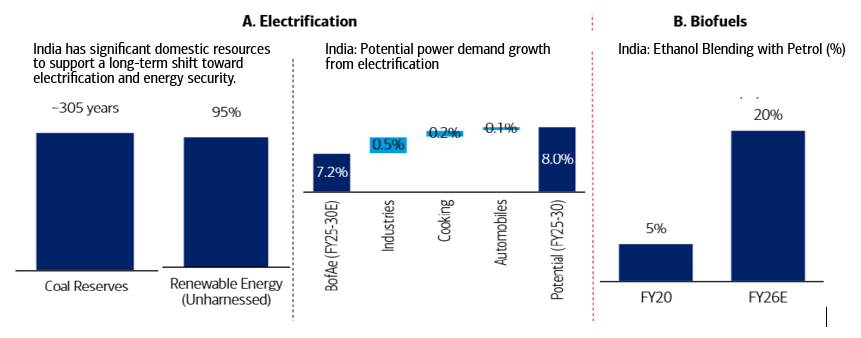
Source: BofA Global Research, 2026
Amish Shah highlights the wider implications for power and infrastructure, noting that data centers, electric vehicles, industrial automation and urbanization are also increasing power demand. This creates opportunities beyond energy production through transmission networks, storage, grid modernization and related infrastructure.
Infrastructure faces a similar test. Railways, ports, power transmission, logistics and data centers all support long-term expansion, but delivery quality matters. In some areas, the constraint is not funding alone, but approvals, supply-chain reliability and coordination across stakeholders. Companies that solve these practical challenges are likely to be among the strongest beneficiaries of India’s future development.
A broader growth base
India's growth is being supported by multiple drivers, although progress is unfolding at different speeds across sectors.
Sachin Salgaonkar, Managing Director of India & ASEAN TMT, Internet Research at BofA Global Research, comments, “Growth is increasingly driven by how digital platforms scale, monetize and deepen engagement.” In digital businesses, the shift is from user growth to monetization. Platforms are no longer judged only on reach. Investors are focused on engagement, payments, logistics efficiency and the ability to convert scale into profitability. Consumer spending is becoming more differentiated. Higher-income consumers continue to spend on premium products, while larger retail chains are gaining share from smaller unorganized businesses and expanding into new cities.
Manufacturing opportunities are emerging in specific segments. India is building competitive advantages in areas such as electronics, defense production, industrial equipment and export-oriented supply chains. The winners are likely to be those that move beyond assembly toward higher-value activities such as components, design and exports.
That is the more important point: India’s growth base is broadening, but the next layer of value creation will come from choosing the right sub-sectors and scaling them well.
AI moves from opportunity to implementation
The conversation around AI has shifted from adoption to application.
Kunal Tayal, Director of India IT, Services/Property Research at BofA Global Research, indicates:
The next phase will be defined by how companies adapt their delivery and commercial models as AI adoption scales.
For India, AI is becoming a business and productivity theme, not just a technology story. It has direct implications for exports, enterprise productivity, customer engagement, software delivery and digital infrastructure. In IT services, companies are evaluating how AI may reshape pricing structures, software development and the delivery of technology services to clients. In financial services, AI can improve risk management, customer servicing and operating efficiency. In digital platforms, it can personalize engagement and reduce costs.
Companies need the right data architecture, compute access, governance and human oversight. The biggest beneficiaries are likely to be those that turn AI into better workflows, faster service delivery and stronger margins. For India, the opportunity is not just adopting AI. It is applying AI at scale in areas where the country already has depth: services, digital platforms, financial infrastructure and enterprise operations.

Kunal Tayal, Director of India IT, Services/Property Research at BofA Global Research, outlines the next phase of AI adoption scaling
Growth in a changing world
The global backdrop matters for India given the impact on energy costs, supply chains, capital flows and export demand.
Global supply-chain shifts continue to create opportunities for India in electronics, industrial production and export-oriented manufacturing. The extent of the benefit will depend on competitiveness, infrastructure and the ability of companies to scale efficiently.
India’s economic trajectory remains strong. What is changing is how growth will be delivered.
India's next phase of growth is likely to be broader, but also more selective. The sectors that can convert demand, investment and structural advantages into sustainable returns are likely to emerge as the strongest long-term winners.
Key questions about India’s next growth phase
What is driving India's next phase of growth?
India’s growth is becoming more selective. The outlook remains strong, but outcomes will depend more on identifying the right sub-sectors, business models and execution priorities.
Why are energy and infrastructure so important?
India’s reliance on imported fuel makes energy security central to long-term growth. Infrastructure matters because logistics, power, transport and digital capacity determine whether investment can scale efficiently.
How is AI changing India's growth outlook?
AI can strengthen India’s services, digital and enterprise capabilities, but the biggest impact will come from practical adoption: improving workflows, delivery models, customer engagement and productivity.

Transforming Japan
With Japan poised for growth, global investors and corporates can capitalize on this compelling opportunity. Explore key insights from our local leaders and Global Research analysts.
Explore more



BofA Securities India Limited (BofAS India) is regulated by the Securities and Exchange Board of India (SEBI) and provides the following services in India: Research, Equity Sales & Trading, Futures & Options, Electronic Trading, Equity Capital Markets, Debt Capital Markets and M&A. SEBI Registration Nos. Research Analyst: INH000000503, Stock Broking: INZ000217333 (Trading and Clearing Member of NSE and BSE – Capital Markets and Equity Derivatives), Merchant Banker: INM000011625, CIN U74140MH1975PLC018618. Registration granted by SEBI, Research Analyst Administration and Supervisory Body (RAASB) of BSE Limited and accreditation from National Institute of Securities Markets (NISM) in no way guarantee performance of the intermediary or provide any assurance of returns to investors. Investment in securities market are subject to market risks. Read all the related documents carefully before investing.
BofAS India’s registered office is at Ground Floor, A Wing, One BKC, G Block, Bandra Kurla Complex, Bandra (East), Mumbai 400 051, India, Tel: +91 22 6632 8000 and the contact details of its Compliance Officer (Shervin Purohit) are: Tel: (91-22) 6632 8853, Email: shervin.purohit@bofa.com For specific grievances, if any, please contact the Grievance Officer (Amish Shah) and contact details are: Tel: (91-22) 6632 8000, Email: dg.rsch_in_complaint@bofa.com If you are not satisfied with the response, you can lodge your grievances with SEBI at SCORES Portal or you may also write to any of the offices of SEBI or file your complaint on the SMART ODR Portal at: SMART ODR Portal. For any queries, feedback, or assistance, please contact SEBI Office on Toll Free Helpline at 1800 22 7575/ 1800 266 7575.
ANB & Co. has completed the annual compliance audit of Research Analyst activities of BofA Securities India Limited for the year ended 31 March 2026, and no adverse findings were found.
A copy of the audit report dated 29 September 2026 is available to our clients on the https://markets.ml.com/