How can healthcare systems evaluate and incorporate technology?
As they seek to take advantage of the best new technologies, leaders must balance value against potential risk.

Curtis Crispin | Director, Healthcare Revenue Cycle and Receipts, Global Commercial Banking | Bank of America

Andres Jimenez | Director, Healthcare Product Lead, Global Payment Solutions | Bank of America
4 minute read
Key takeaways
- Health systems need to examine a vendor’s profitability, priorities and sustainability before partnering with them.
- Whether a health system develops its own AI solution or turns to a vendor’s tool, staff buy-in is essential for successful adoption.
- As healthcare is a patient-centered service, overall patient experience can sometimes overrule the financial ROI of a new piece of technology.
How can healthcare systems best evaluate and apply technology within the revenue cycle? What’s the most effective way to balance the value of new technology products with the potential risks? Revenue cycle leaders from diverse healthcare systems — ranging from community hospitals to large academic centers — shared their candid opinions and experiences in a small-group session sponsored by Bank of America at the recent HealthLeaders RevTech Exchange. The attendees addressed several big-picture questions about how to safely and effectively incorporate new technologies into their operations.
Q: How much risk is inherent in working with tech vendors, and how can health systems manage those risks?
These revenue cycle team leaders discussed several levels of risk in partnering with today’s healthcare technology vendors. There’s a recognition that smaller, up-and-coming tech vendors — particularly startups — have divided loyalties. These vendors may prioritize investor expectations over client needs as they work to begin a new round of funding or prepare to go public. Beyond that, given the active M&A climate in the tech industry, there also is an obvious ongoing concern that a tech vendor and its platform could be acquired by another company and then sunset by the new owner. That could potentially wipe out a healthcare system’s investment completely or create all sorts of potential operational problems, conflicts and security issues — issues that might not exist with a more established firm or technology partner.
Attendees also acknowledged the risk of a dominant tech vendor owning too much of the market — and what might happen if that company were sold, changed leadership or went out of business.
In short, healthcare organizations are working to take advantage of the best new technologies — with a cautious eye. The pace of change in available technologies means a preference for short-term contracts, both for flexibility and to hedge against risk. System leaders also look for meaningful answers about a vendor’s profitability and sustainability before committing to even a short-term contract.
“The pace of change in available technologies means a preference for short-term contracts, both for flexibility and to hedge against risk."
Q: Is it better to have a smaller or a more diversified set of vendors when planning the organization’s cyber resilience?
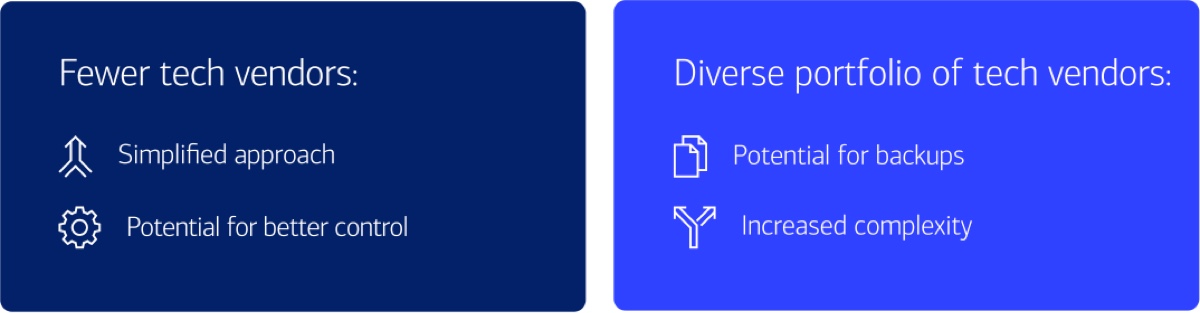
Every system today is on alert for a cyberattack; the downtime and subsequent cleanup created by a major attack creates operational chaos and lost revenue. When thinking about how to most effectively protect against cybercrime, system leaders continue to question whether it’s better to have a short list of vendors for simplicity and potentially better control. Does a diverse portfolio of tech vendors provide backup and redundancy in case of problems, or does a longer list of suppliers only create complexity in using technology throughout the system? Leaders acknowledge that there are tradeoffs to both approaches.
To optimize cyber resilience, what's the right number of vendors?
Q: What factors determine whether generative AI capabilities should be built internally versus bolted on from third-party vendors?
While building your own AI projects can often deliver major efficiency gains and ensure better controls, it’s usually only larger healthcare systems that can manage those types of initiatives; smaller systems may need to rely on external vendors. Although third-party, bolt-on applications are generally more accessible and faster to implement, IT teams say they feel more comfortable with the data security and controls inherent with internally built projects. Whether a system invests the time, resources and manpower to develop an AI system of its own or turns to a vendor’s tool, the focus needs to be on staff buy-in in order to ensure AI is successfully adopted throughout the organization.
“IT teams say they feel more comfortable with the data security and controls inherent with internally built projects."
Each organization is likely to assess the ROI of these new technologies differently based on its C-suite’s priorities. And because healthcare is a uniquely patient-centered service, overall patient experience can sometimes overrule the financial ROI of a new piece of technology — either positively or negatively.
Contact your Bank of America Healthcare representative to discuss these topics or ways we can help.

Navigating healthcare transformation and uncertainty
Discover the latest insights from Bank of America and HealthLeaders on innovations in technology and healthcare.