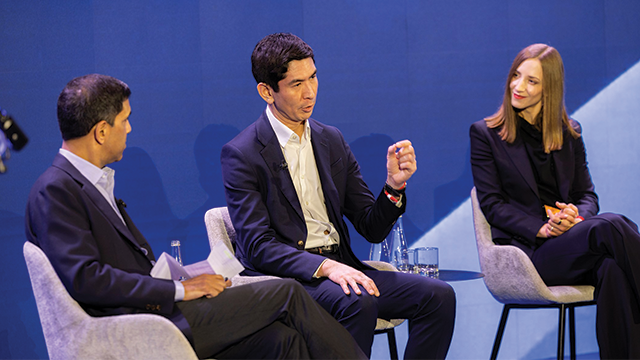
Disruptive defence: Mobilising innovation and investment to advance security in Europe
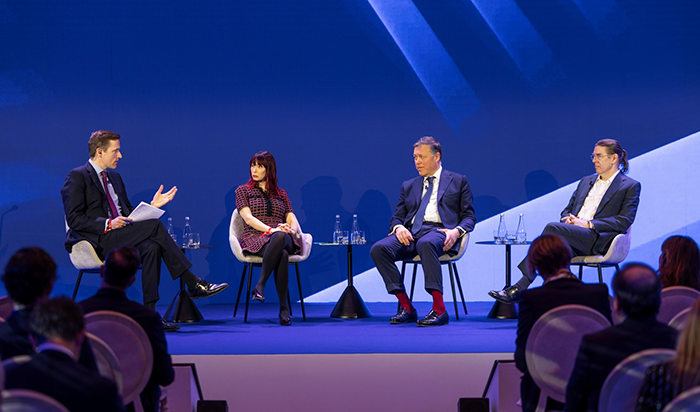
Wilfred Frost, Sky News Presenter, Host of Mornings with Ridge & Frost
Dr Benedetta Berti, Secretary General, NATO Parliamentary Assembly
Lord Franck Petitgas, Vice Chair Europe, Blackstone
Alex van Someren, Former Chief Scientific Adviser for UK National Security
Key takeaways
- Despite an increased focus on defence and autonomy, Europe’s capacity to promote its interests on the international stage remains limited
- The continent’s coordination strategies and procurement cycles urgently need to be overhauled to reflect a rapidly changing security landscape
- Encouraging defence ‘disruptors’ has the potential to unleash new technologies and sources of capital
Conflict may be a near-constant on the global stage, but in the eyes of the veteran diplomats and defence experts attending the Bank of America Global Investor Summit 2026, recent events have underlined that its consequences have become far more widespread, and unpredictable. Large powers are more willing to wield power unilaterally and without constraint, while new technologies have given smaller actors the capacity to project force in ways that vastly exceed their conventional footprints.
This has created an uneasy dynamic where even in the absence of overt military action, much of the world lives under the shadow of potential cyberattacks, economic sabotage, state-sponsored assassinations and threats to critical infrastructure “not at war, but not at peace either.”
There is an urgent requirement to reshape defence strategies for this new, messier reality, and perhaps nowhere more is this true than in Europe, where the expansion of hostilities in the Middle East has added to concerns stoked by the ongoing war in Ukraine. On a panel that evaluated Europe’s capacity to “act as one” on defence and other areas of strategic importance, participants agreed that Russia’s invasion of Ukraine — and the U.S. President Donald Trump — had spurred the continent to commit more resources to security, and to make some important decisions faster. Strategic autonomy, too, is no longer perceived in Brussels as a somewhat distasteful concept.
At the same time, in matters of defence and diplomacy, Europe is often still relegated to playing the role of bystander — even in its own backyard, as is evident in its exclusion from stop-start negotiations between the U.S. and Russia over the fate of Ukraine. One former European leader remarked that these talks were shaping security on the continent “with Europe on the menu, and not around the table.”
Shifting from ‘breakfast’ to ‘breaking things fast’
Part of the challenge is that for all the efforts to forge a united front, members of the European Union still prioritise individual policies and interests, especially in matters that touch on national sovereignty, like armaments. The result is that “Europe is not as focused as it could be on developing a coherent defence strategy, procurement or defence industrial base,” noted Bernard Mensah, President of International, Bank of America.
The region must also strike a difficult balance in the defence aspects of its relationship with the United States. While some panellists argued that ultimately, there is no plausible alternative to the transatlantic alliance and the NATO security architecture, others emphasised the need to reduce dependence on an increasingly unpredictable partner. There was a sense among panellists that the time may be ripe for such a shift, with rising public support for European investment in defence to serve greater strategic goals.
To be successful Europe must update the methods and targets of its defence investments to reflect changes on the ground. First and foremost, experts see a need to significantly accelerate procurement cycles, so they align more closely with the rapid development of the software and technologies that are beginning to dominate the modern security arsenal. As one panellist noted, Ukraine is proving an inspiration to the rest of Europe: there, defence innovation cycles are measured not in years, but in weeks.
Also required are more investments in electronic warfare and energy weapons, as well as detection capabilities to increase insights into the threat environment. All this could help Europe adopt a more layered, proportionate response to attacks, resolving the current damaging “asymmetry” exemplified by expensive, difficult-to-make interceptors being used to shoot down cheap, mass-produced drones.
Military-industrial complexities
The good news, according to experts speaking on another panel that focused on Europe’s defence industry, is that private capital is already being channelled to help meet these changing needs. Europe’s defence primes have prospered in recent years,1 and the sense of urgency around defence provoked by the current overlapping crises could mark the start of a long-term structural bull market.
What’s more, European ‘disruptors’ are emerging that show the continent can produce companies innovative enough to challenge established defence giants. The best of these will attract significant investor interest and could even help Europe leapfrog strategic rivals in some emerging fields.
In the eyes of panellists, seizing on this opportunity will require European governments to temper their desire to groom national, or even EU, champions. One senior European statesman argued for a European equivalent of the U.S. Defence Advanced Research Projects Agency (DARPA), which would allow for a more integrated approach to procurement and the mobilisation of investment. Cooperation could extend to “coalitions of the willing” that could eventually include non-EU countries like the UK.
Other speakers were more sceptical of coordinated government action. As one senior leader at a defence startup noted: national authorities generally have a poor tracking record of picking winners, and an instinctive risk aversion that prevents them from making big bets. Yet when it comes to defence, doling out funding piecemeal is “probably the worst thing you can possibly do if you really want to build a resilient, sustainable sovereign supply chain.”
As well as efforts to strengthen ties both within the EU and with like-minded external partners, a safer, better defended Europe may therefore require higher levels of discomfort — and a stronger appetite for financial risk. Yet at the same time, the power of investment capital is already combining with start-up innovation to harness technology for transformative defence purposes. If Europe can continue to foster the conditions necessary for this benign disruption, the rapid emergence of new security threats may be countered by the equally rapid emergence of systems able to neutralise them.
Inference from interference: Looking past shocks to pursue long-term value
The leaders from the worlds of finance, business and policy who gathered at Bank of America’s flagship international event are no strangers to risk, or high-stakes situations.