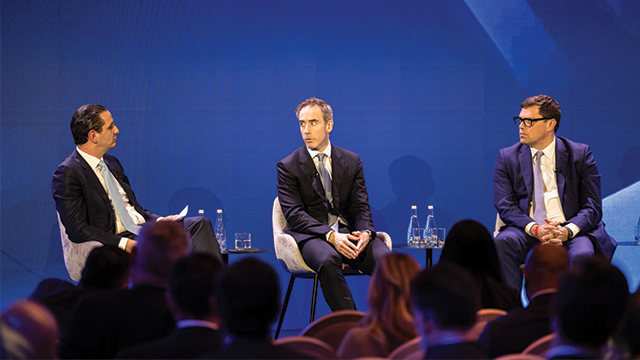
Boundaries of Power: The emerging manual for Artificial Intelligence
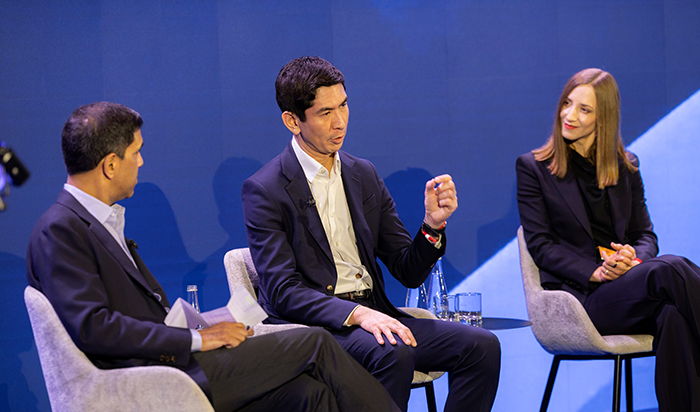
Faiz Ahmad, Co-Head, Global Investment Banking, Bank of America
Dex Hunter-Torricke, Founder & President, The Center for Tomorrow, former Head of Communications, Google Deepmind
Cassie Kozyrkov, CEO, Kozyr LLC, Former Chief Decision Scientist, Google
Key takeaways
- The race for AI supremacy is now a geopolitical competition, not merely a commercial one, creating a “government-sponsored bubble”
- With trust in short supply, companies that build confidence by setting clear boundaries for AI will gain a competitive advantage
- Establishing trust will enable AI to be further embedded in areas such as medicine, where its benefits could be transformational globally
The conversation around artificial intelligence (AI) has changed. Optimism is giving way to concerns around AI’s impact, both immediate and long-term. How can it be made safe — or is that even possible? How should its makers, and users, decide when AI’s social consequences outweigh any efficiency or economic benefits?
At the 2026 Bank of America Global Investor Summit, some of the world’s leading AI thinkers, practitioners and investors gathered to debate where and how a consensus on these difficult questions is emerging — and what may come next.
For this reason, the EU is prioritising technological autonomy from the U.S., amid what is turning into an AI arms race. “Pressure around Europe is pushing the idea of strategic autonomy into more and more areas,” noted Bernie Mensah, President of International at Bank of America. “If we take the area of AI and digitization in general, clearly Europe faces an existential question about relying on the U.S., given its already huge dependence on U.S. technological resources.”
This element of statecraft has implications for investors. “The perceived AI bubble could get a lot bigger, because it’s now a government-sponsored bubble and strategic policy,” Michael Hartnett, BofA Global Research, Chief Investment Strategist, told the summit, while noting the sector’s scope for equity outperformance had nevertheless subsided.
Real intelligence vs. AI theatrics
Questions around the boundaries of AI have become so fraught that some AI experts noted establishing firm guardrails now represents an area of competitive advantage. At a time when trust is at a premium, AI applications that can win that trust will attract a wider and potentially more committed user base.
Skillsets that can identify the necessary boundaries, whether ethical or technological, will be in high demand — perhaps in even higher demand than raw technology expertise. This extends to being able to communicate clearly with AI in order to set parameters and perimeters. The pitfalls of “vibe-coding” will become apparent; apps built on intuitive prompts rather than rigorous engineering will likely lack safety nets, with plenty of scope for problems given that AI’s non-deterministic nature by definition leads to unpredictable results.
Setting clear parameters and defining measurable outcomes is also vital to avoid accusations of “AI theatre,” panellists agreed. Much like “greenwashing” as applied to environmental factors, this refers to companies which proclaim their embrace of AI in order to impress investors and customers but fail to establish the pathways and benchmarks needed for AI to become integral to their operations.
Panellists suggested that one tell-tale sign of AI theatre is if a company has no stated criteria for declaring its application of AI a failure — a “kill switch” of sorts. Signs of genuine AI adoption, by contrast, are the transformation of specific processes: not only those that utilise AI directly, but also ‘offline’ ones like employee work routines that can change as a secondary consequence.
Remembering the upsides
The experts attending the Summit made it clear that everything from the power demands of future AI data centres — which could be radically reduced by new innovations, including quantum computing — to breakthrough models and the technology’s ultimate commercial winners and losers remain ‘known unknowns.’ But they also agreed it was already clear that the economic and human benefits of AI are potentially enormous.
One panellist noted the U.S. state of Utah, authorities are working to give AI the power to manage repeat prescriptions of low-risk pharmaceutical drugs to treat chronic conditions.1 If Utah avoids a jurisdictional turf war with the Federal Drug Administration, which regulates medical devices, the result could have multiple positive impacts, from closing gaps in treatment cycles to freeing up human physicians for more critical tasks.
The phrase “let a thousand flowers grow” is apt for the current moment. Delegates noted much of the best innovation is coming not from software engineers, but from subject-matter specialists who are using the accessibility of natural language processing to transform how they interact with their own domains of expertise. The complexity of this discovery process should not be interpreted as confusion or chaos, but as a phase that brings the world closer to agreeing AI best practice — and to a new operating manual for almost every profession and industry.
1 Utah Department of Commerce, "Utah and Doctronic Announce Groundbreaking Partnership for AI Prescription Medication Renewals"

Disruptive defence: Mobilising innovation and investment to advance security in Europe
Conflict may be a near-constant on the global stage, but in the eyes of the veteran diplomats and defence experts attending the Bank of America Global Investor Summit 2026, recent events have underlined that its consequences have become far more widespread, and unpredictable.