Securing the cloud: How to help protect your company’s deployment
Understanding the protections your cloud providers supply — and where your organization needs to take the initiative – is mission critical. Here are steps you can take to stay cyber-secure in any cloud environment.
Key takeaways:
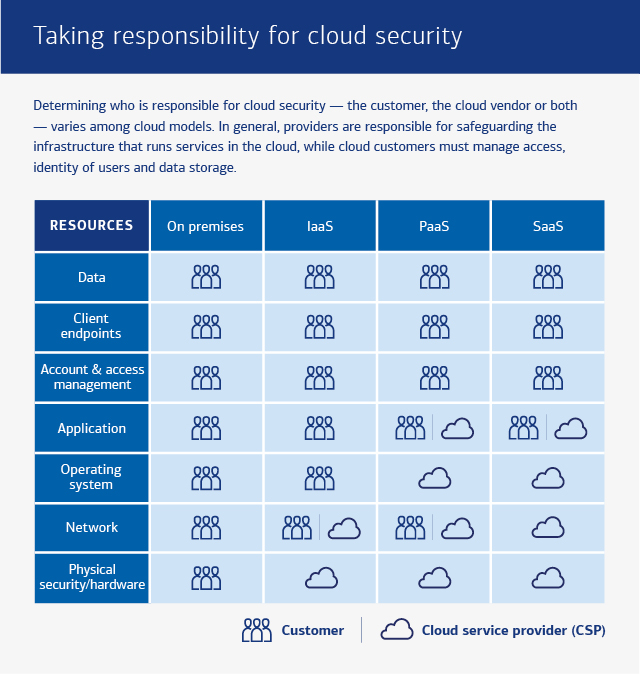
- Cloud security is a shared responsibility. Your cloud provider protects infrastructure; your organization must maintain strong access management and data controls.
- Your policies around identity and privilege management are crucial to maintaining security within cloud environments.
- Planning for a breach and developing a cyber incident response plan is required of any business using cloud tools and platforms.
Cloud services are now essential for most businesses. Hybrid setups (mixing private and public clouds) and multi-cloud setups (using multiple public providers) give companies flexible storage, real-time communication and collaboration, and the ability to connect teams, systems and devices. Cloud deployments can also scale quickly, helping organizations support new partners, customers, and remote workers with minimal delay.
However, these environments also present cybersecurity risks. Criminals continue to target unpatched systems, weak identity practices and vulnerable partners in the digital supply chain. Misconfigurations, unauthorized cloud use, and poorly managed access can expose sensitive data and lead to compliance issues.
Cloud service providers (CSPs) offer a robust security apparatus around their products and services, but these companies are not solely responsible for secure cloud deployments. As just one example, while most CSPs offer data encryption capabilities, users typically must opt in to access them.
Whether your company uses Software as a Service/SaaS (e.g., email or data storage), Platform as a Service/PaaS (e.g., app building kits) or Infrastructure as a Service/IaaS (e.g., hybrid or multi-cloud architectures), securing your cloud deployments is a shared responsibility between you and your CSP. Specifically, your organization must create policies and controls that protect critical data, account access and the physical security of any device connecting to your cloud.
As a best practice, cloud security should follow many of the same principles that govern the security of on-premises environments. However, it’s critical to recognize the key differences between on-premises and cloud environments — particularly in ownership, scale and how security controls are implemented and enforced.
Here are steps your organization can take to improve and maintain security in your cloud deployments:

Fraud & Cybersecurity
New threats emerge every day that can negatively impact transactions and businesses. Explore the latest insights and resources to help prepare and protect you and your business.