Contactless payments: A foundational shift for merchants
The rise of contactless payments has been years in the making. Early digital wallets introduced a more convenient way to pay, shifting consumer expectations and accelerating the adoption of contactless. Since then, financial institutions have moved quickly to catch up to early innovators like Apple Pay® or Google Pay™, pushing contactless payments into the mainstream.
7 minute read
Key takeaways
- Contactless, especially tap-to-pay, is now the default payment method, while digital wallets are becoming broader personal and financial platforms.
- For merchants, getting up to speed doesn’t mean a full transition all at once but can begin with a few key steps.
- Financial institutions are continuing to drive adoption of digital and contactless payments, and innovations are emerging all the time.
Digital has become an integral part of banking services
Consumers now expect digital to be part of their banking lives. In response, merchants have moved toward entirely cashless models, taking advantage of improvements to the acceptance infrastructure, like network tokens and enhanced near-field communication (NFC) capabilities.
“When a consumer opens an account with a participating bank or credit union today, they automatically get access to a Paze digital wallet as part of their banking services. That’s part of a long evolution from paper checks to cards to online accounts and now contactless.”

Contactless is the default way to pay
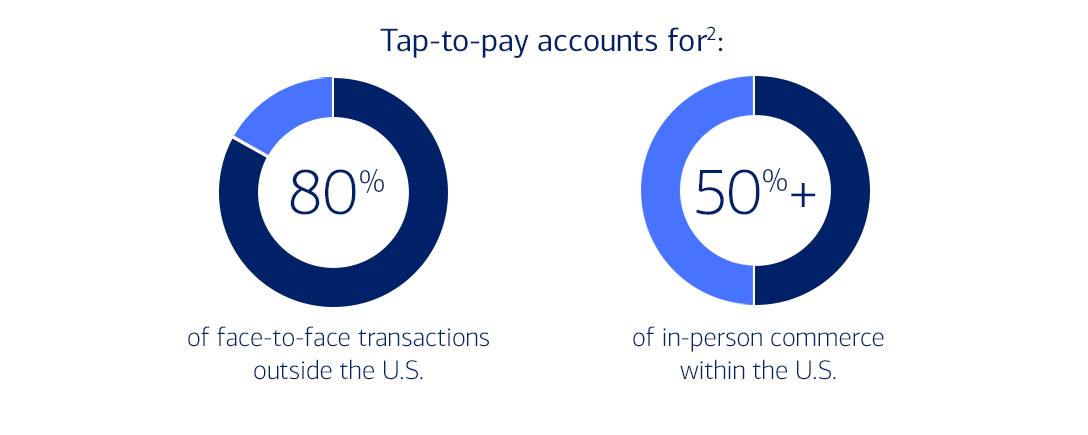
Contactless payments have moved from convenience to standard. Consumers prefer tap-to-pay because it’s easy, fast and secure. In fact, global infrastructure is now fully “tap-ready,” with 89% of global POS terminals accepting contactless payments.1
Transit is reinforcing daily use3:
- New York City has fully replaced MetroCard with OMNY (One Metro New York) as its contactless fare payment system for public transit.
- By March 2025, 65% of riders used contactless.
- 85% of full-fare and 55% of reduced-fare riders now tap-to-pay.
How to get up to speed
For many businesses, the shift is more about operational readiness than adoption trends. While some merchants are fully equipped, others are still in transition. But getting started doesn’t require a full transformation — it can begin with a few key steps:
- Assess your acceptance capabilities
- Prioritize the enhancements that will have the most impact
- Reinforce the availability of contactless at POS
- Ensure your plans are scalable
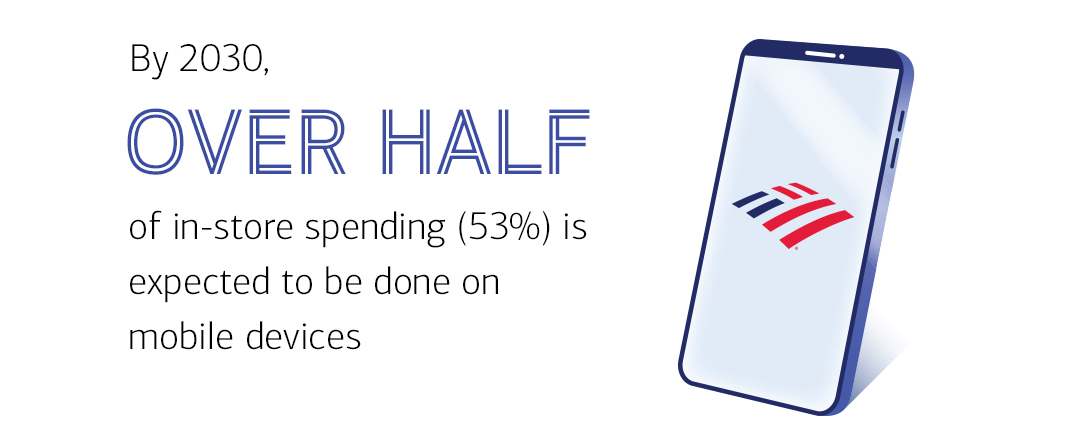
Also consider that smart phones have essentially become contactless payment terminals that don’t need any additional hardware or peripherals. Adoption of tap-to-phone technology is surging, with Visa reporting 200% year-on-year growth.4 By 2030, over half of in-store spending (53%) is expected to be done on mobile devices, and QR codes are already an established part of the payments infrastructure as companies and merchants have become more technology proficient.5 This increased payment optionality means that payments can be accepted by businesses ranging from micro merchants to sports stadiums.
The evolution of digital wallets
Digital wallets are expanding their capabilities beyond payments. The ability to do things like store your driver’s license in Apple Wallet shows how they’re becoming part of everyday life. They’ve moved from being a simple way to check out at a store to something that people can use to prove who they are, access services and handle simple daily tasks.
Adoption is growing across all age groups, driven by biometric security and easier setup, and solutions that simplify and secure online transactions are playing a key role in this. One example of this evolution is Paze®. This simplifies online checkout by eliminating manual card entry. Offered by Bank of America and other leading banks and credit unions, Paze combines eligible debit and credit cards into one wallet, with added security through tokenization so that actual card numbers are not shared with merchants. With more than 165 million cards added and a growing list of merchants, Paze delivers a fast, easy and convenient checkout experience for everyday spending.6
A digital future
“Financial institutions are well positioned to continue to drive adoption within digital and contactless payments, and innovations in the space are emerging all the time,” says Parks. Developments to watch include:
- Tap-to-own-phone — piloted by Visa, this gives consumers the ability to pay for online purchases by tapping their physical card on their own NFC-enabled Android, removing the need to manually enter card details.7 It’s a significant change in the payments ecosystem as it allows for a card-not-present ecommerce transaction to be processed as card-present, securely leveraging the consumer’s phone as a personal payment terminal.
- Tap-to-confirm to authenticate high-risk actions.
- Tap-to-activate to confirm card activation.
- Tap-to-add-card — this adds a card to a digital wallet with just a tap, without the use of a key entry or phone camera.
- Tap-to-phone at ATMs — Bank of America offers contactless (NFC)/cardless ATM access, allowing consumers to tap their phone instead of inserting a physical debit card.
For merchants, digital payments are more than a trend to keep up with. They’re about meeting customers where they are and providing a fast, simple checkout while keeping lines moving and sales flowing. It comes down to this — if you don’t offer easy, contactless options, you create friction that could cost transactions and deter repeat business.
Strengthen your own contactless payment readiness. Talk with a Bank of America Merchant Services representative today.
1 Datos Insights. The Changing Face of Global Card Payments.
2 PYMNTS, Visa: 80% of Face-to-Face Transactions Internationally are Tap to Pay.
3 MTA, MTA to Sunset MetroCard Sales at End of the Year.
4 Visa, Visa Tap to Phone Adoption Soars: 200% Year-over-Year Growth Worldwide.
5 WorldPay, GPR 2025. The past, present and future of consumer payments.
6 Paze® and the Paze related marks are wholly owned by Early Warning Services, LLC and are used herein under license.
7 Visa, Visa launches new disruptive payment solution in Latin America and the Caribbean.
Apple Pay is a registered trademark of Apple Inc.
Google Pay is a trademark of Google LLC.

Merchant Services
Payments are more than transactions. At Bank of America, they are a relationship. A relationship powered by technology and driven by our 24/7 commitment to the growth and success of your business.