Optimizing liquidity for life sciences companies
Every startup business knows the importance of having capital on hand. But for life sciences companies, managing liquidity and foreign exchange (FX) isn’t just important — it can be a matter of survival.


9 minute read
Key takeaways
- The development framework of life sciences innovators requires significant capital, making liquidity critical.
- Building the right financial structures, taking a global view and treating treasury as a strategic partner can boost available capital.
- A global banking partner can help manage liquidity and FX while navigating uncertainty.
Liquidity and FX are strategic enablers
Like many life sciences innovators, these companies consume significant capital during lengthy research and development cycles. Even after a product is developed, they often face an extended regulatory approval period during which revenues remain elusive — making liquidity critical until both approval and commercialization are achieved.
This development framework means these companies live at a unique intersection of capital intensity, extended innovation cycles, and globalization — because once a product is approved for market, it typically goes global and at a rapid pace. One well-known example is the fast-moving development and deployment of the mRNA COVID-19 vaccines.
For these new economy companies, liquidity and foreign exchange (FX) management have evolved from operational requirements into strategic enablers — especially in today’s volatile regulatory environment. When smartly managed, access to capital can support growth and innovation, provide financial backup in uncertain moments, and allow executives to make the best decisions. The key is optimizing liquidity and FX management with the right approach, structure and expectations.
High stakes amid uncertainty
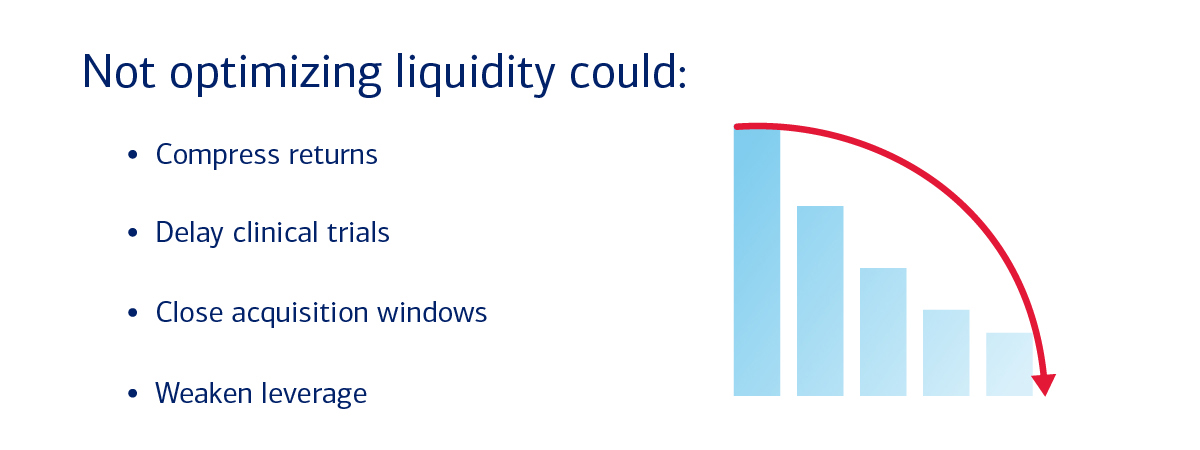
The stakes are always high. “For companies like these, getting liquidity wrong does not just compress returns — it can delay clinical trials, close acquisition windows, or materially weaken negotiating leverage at precisely the wrong moment,” says Stefan Leijdekkers, Global Commercial Bank Treasury Executive for Bank of America.
The stakes are even higher today amid a persistently volatile market environment, where regulatory uncertainty — and the resulting delays in approval and commercialization — are an ongoing reality rather than an exception. Yvette Hawkins, Transformative Healthcare Group Executive for Bank of America, notes: “For these companies, the number one priority is preserving capital and ensuring liquidity. That liquidity is required not only to fund monthly operations, but also to optimize balances over extended periods of uncertainty. In the protracted volatility we’re seeing today, having both a domestic and international perspective on liquidity strategy has become essential to safeguarding capital and ensuring companies can reliably fund their operations.”
“Having both a domestic and international perspective on liquidity strategy has become essential to safeguarding capital and ensuring companies can reliably fund their operations.”
Approvals often start at the U.S. Food and Drug Administration, where workforce reductions, leadership transitions and policy shifts have increased uncertainty around review processes and timelines. Combine that with uncertain macroeconomic conditions, including on-and-off tariffs, interest rate fluctuations and international conflicts that directly affect sales and profit forecasts. Says Hawkins: “After several years of sustained volatility, CFOs are under greater pressure to ensure their capital and liquidity strategies are not only thoughtful, but durable — clearly tied to runway, risk tolerance, and operational priorities.”
“CFOs are under greater pressure to ensure their capital and liquidity strategies are not only thoughtful, but durable.”
Building a financial framework
The first step is understanding that optimizing liquidity and effectively managing foreign exchange rates is not about extracting the last basis point. It is about building a financial framework to ensure capital is available when needed or when opportunity arises. “There is no single tool that solves for FX or liquidity,” Leijdekkers says. “Getting it right requires treasury to sit alongside the CFO in capital planning discussions, shaping decisions before market volatility forces them.”
“Getting it right requires treasury to sit alongside the CFO in capital planning discussions, shaping decisions before market volatility forces them.”
That means treating treasury as a strategic partner for company leaders, not merely a transactional function. Treasury’s strategic mandate includes input into critical decisions: to manage the burn rate, scale with confidence, enable expansion and M&A, and fund long-term growth.
Optimizing liquidity is, of course, about ensuring that cash is available when and where it is needed, while minimizing friction, fees and balances that can be trapped in overseas markets. Fee transparency and structural efficiency matter as much as return; focusing on yield can add complexity and risk, especially in a volatile market.
To optimize liquidity, a company’s financial management should include scalable and efficient account structures, and intentional positioning across operating cash, invested liquid assets and earnings credit rate. Too much complexity can limit access to cash in fast-moving environments. “For life sciences organizations, the cost of illiquidity is rarely incremental — it is strategic,” says Leijdekkers. Similarly, foreign exchange management should be treated as a structural discipline.
“For life sciences organizations, the cost of illiquidity is rarely incremental — it is strategic.”
Volatility in the foreign exchange rate not only affects the margin on products, but also the length of the runway if the company is starting to generate cash. “There needs to be sufficient certainty in international cash flows to support informed decision making,” Leijdekkers says. “The ability to forecast revenues and cash with confidence is central to valuation, capital planning, and investor trust.”
Companies should treat market volatility as the norm while planning ahead. Foreign exchange risks are persistent, not episodic or transitory — and the ability to move currency can help or hinder profit margins, the length of runway and longer-term forecasts.
Boosting financial resilience
Hawkins and Leijdekkers say a global banking partner like Bank of America can help manage liquidity and FX — not only by providing global account visibility, but by helping companies see light at the end of that long tunnel of research, approval and global commercialization. “We have worked with many new economy companies at this exact inflection point. That experience allows us to help clients anticipate liquidity and FX challenges before they constrain growth,” says Leijdekkers.
Part of that story is understanding that with clear governance, actionable metrics, and board-level visibility, treasury becomes more than a function — it becomes a strategic system that supports innovation, care delivery, and long-term growth. It connects the executive vision with operational timing and execution reality.
“Life sciences companies are solving problems that have long been out of reach for humanity,” Leijdekkers says. “Helping them bring those therapies to market — while ensuring the financial resilience to sustain the journey — is deeply meaningful work.”
To learn more about how our Transformative Healthcare Group can help your organization, contact a Bank of America representative today.

Shaping the future of healthcare
Our Transformative Healthcare Group can help your healthcare organization integrate emerging technologies and modernize your operations.