
What do employers need to know about state-sponsored retirement programs?

Key takeaways

  • Increasingly, states are requiring businesses to offer retirement plans to employees
  • State-sponsored retirement programs can offer a simple, low-cost way of meeting these requirements
  • Employer-sponsored retirement plans are more flexible and full-featured


Workers in the U.S. have long been facing a substantial retirement plan coverage gap. In fact, only about 50% of workers in the private sector participate in an employer-sponsored retirement plan.1 The biggest reason? Their employers simply don’t offer one. To help close this gap, many states have introduced retirement programs, some of which require employers — including sole proprietors and the self-employed — to participate. As these programs expand, business owners have more options than ever. But making the right choice means first understanding how these programs work, what may be required of your business and which alternatives are available.


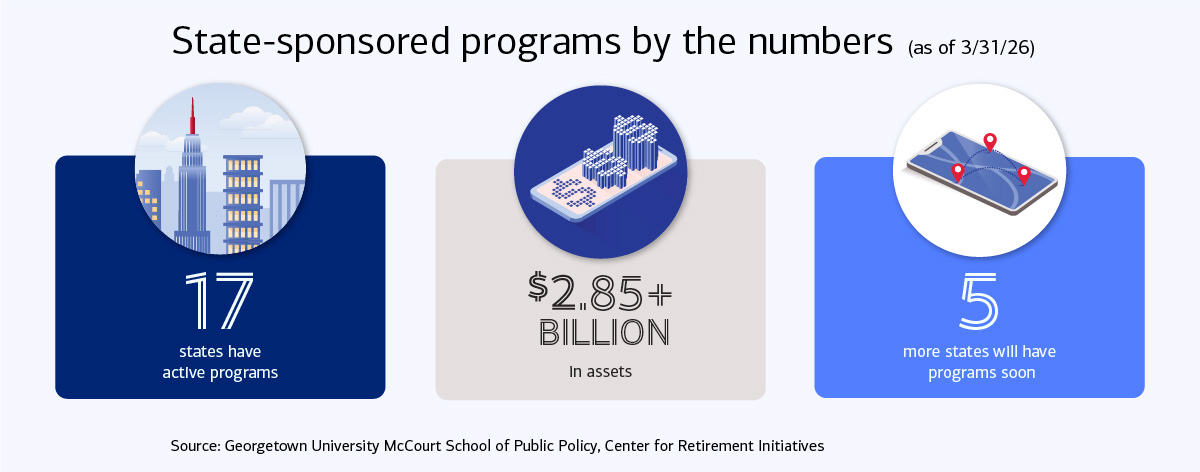
State-sponsored programs by the numbers. For full description, activate the "Show text version" link.

What is a state-sponsored retirement program?

State-sponsored retirement programs are created by individual states to provide more employees with a way to save for retirement — especially those whose employers don't offer plans. Here’s what you need to know about them:


States set up and run the programs

Each program is established and managed at the state level, making it a simple way for employers to meet that state’s participation requirements.


They’re usually offered by states with a retirement plan participation mandate

Many states require businesses with employees — sometimes including sole proprietors and the self-employed — to offer a retirement plan, either by setting up their own or enrolling in the state program.


Automatic enrollment is the norm

Employees are typically enrolled by default through payroll. However, they can opt out or adjust their contribution amount at any time.


Contributions typically go into a Roth IRA

In many programs, employee contributions are made aſter tax to a Roth IRA. However, the program structure and features will vary by state.


They’re designed to be straightforward

Employers generally have limited administrative responsibilities, such as registering for the program, helping ensure eligible employees are enrolled, processing contributions through payroll and keeping employee information up to date.


Employer contributions are usually not allowed

Most state-sponsored programs don’t allow employers to make matching or other contributions to their employees’ accounts.


Which states offer retirement programs?

As of April 30, 2026, 22 states have enacted new programs for private sector workers. But nearly every state in the U.S. has at least considered legislation to establish state-facilitated retirement savings programs, so this number is expected to grow.


State-sponsored programs vs. employer-sponsored programs

While both are designed to facilitate saving for retirement, there are a number of key differences between employer-sponsored plans and state-sponsored programs.


Column Header
Column Header

Employer-sponsored plan

Column Header

State-sponsored program

Pre/post-tax contributions

Both options available

Post-tax only (auto-IRA)

Employer match or other contributions

Optional

Not allowed

Employer tax credits

Eligible

Not eligible

Investment lineup

Wide range of funds available

Limited; Often target date funds 

What factors should you consider?

State-sponsored retirement programs are designed to offer a simple, accessible path to compliance with minimal effort. However, some employers may prefer employer-sponsored plans, which offer more flexibility and long-term value for their business and employees.


Understanding the differences can help you decide which aligns best with your goals.


Why a state‑sponsored program?

Business owners often choose state programs when they are looking for:


  • Low cost — Typically, minimal or no direct employer fees
  • Simplicity — Designed to be easy to set up and maintain
  • Minimal administration — Limited employer involvement after initial setup
  • Straightforward way to meet applicable state requirements


Why an employer-sponsored plan?

As businesses grow, some employers begin to look for features that go beyond basic compliance, such as:


  • More savings flexibility — Higher contribution limits and broader participation options
  • Additional ways to support employees — The ability to contribute as an employer or offer a more competitive benefit
  • Greater investment choice — More options to align with individual preferences and financial goals
  • Plan design flexibility — The ability to tailor a program to the needs of the business
  • Long‑term scalability — A solution that can evolve as the business grows
  • Employer tax advantages — Costs associated with employer contributions and plan expenses are generally deductible from the employer’s income2


Putting it into perspective

For many businesses, state-sponsored programs are a practical way to meet applicable state requirements. For others, they’re a first step before exploring alternatives that offer more flexibility, customization and long-term value. Ultimately, there isn’t a one-size-fits-all answer. But with some careful consideration, you can find the option that best fits where your business is today — and where you want it to go tomorrow.


1Center for Retirement Research at Boston College, Can Service Providers Convince More Small Firms to Offer 401(k)s?, May 5, 2026.

2 Retirement Plans Startup Costs Tax Credit. For more information, visit the IRS website, irs.gov/retirement-plans/retirement-plans-startup-costs-tax-credit.