
Happy employees, thriving business: The impact of workplace benefits
Discover how workplace benefits drive employee happiness and empower small businesses to achieve lasting success.
Written in partnership with YFS Magazine.
Employee engagement goes beyond boosting morale—it’s a catalyst for small business growth. Happy, engaged teams uplift one another and help drive meaningful business outcomes.

Lorna Sabbia
Head of Workplace Benefits
Bank of America
"At every core of every small business are the employees who keep things running," says Lorna Sabbia. "Ensuring they feel happy and well cared for is essential."
A Gallup meta-analysis links engagement directly with profitability, productivity, and loyalty.1 Yet, many businesses underestimate the strategic value of workplace benefits in nurturing engagement. Well-designed benefits are an investment: they increase engagement, reduce turnover, enhance performance, and ultimately support sustainable growth.
The strategic ROI of ‘happiness benefits’
Focusing on results is important—but so is recognizing how employee happiness fuels those results. Research continues to support the strong connection between happiness and engagement.2 When employees feel secure about their health and financial future—thanks to healthcare, retirement plans, or financial wellness programs—they’re more energized and effective at work. Optimism and motivation follow.
Bank of America data shows that 65% of surveyed employees are optimistic about advancing their careers in the coming year. This sense of wellness translates into business gains. As Harrison Tang, co-founder and CEO of Spokeo, notes, “Investing in employee happiness translates into stronger online ratings on platforms like Glassdoor and Indeed.”
Public perception can help attract top talent, but the internal payoff is just as vital. For example, CEO Nikita Sherbina of AIScreen observed after offering new wellness perks, “Providing workplace benefits that genuinely enhance employee happiness transforms a business from the inside out.” These steps delivered a 20% improvement in project efficiency and cut turnover significantly.
At OpStart, a new 401(k) with employer matching proved its worth. Maurina Venturelli, Head of GTM, said, “The biggest business advantage I see from happiness-focused benefits is dramatically lower replacement costs and faster growth execution.” OpStart reduced voluntary turnover by 60% and saved about $180,000 yearly in recruitment and training expenses.
It’s clear: Investing in employee happiness through thoughtful workplace benefits isn’t just feel-good—it’s strategic. The benefits ripple out: stronger engagement and performance, lower turnover, and reduced hiring costs.
Cameron Prockiw, founder of Nerder, underscores this point: “One overlooked advantage of workplace benefits is how they quietly lower your cost of acquisition and retention.” By prioritizing well-being, small businesses unlock a cycle where happiness powers engagement, and engagement drives business results.
Workplace benefits as a tool for talent management
A robust small business benefits package is vital to attracting and keeping talent. Replacing an employee can cost up to 200% of their salary, per Gallup.3 Often, that’s more than the cost of a competitive benefits plan.
Comprehensive benefits send a clear message that a business values its team. This fosters loyalty and reduces turnover. Aaron Whittaker, VP of Demand Generation & Marketing at Thrive Internet Marketing Agency, shares: “The happiness connection comes from employees feeling valued and supported beyond just their paycheck, creating emotional investment in the company’s success rather than viewing their job as purely transactional.” That investment builds a strong reputation, attracting more talent.
Workplace benefits also strengthen company culture and relationships. Bradford Glaser, president and CEO of HRDQ, says, “Rewards that promote happiness make individuals stick together better, and those relationships directly power productivity, creativity, and retention over the long term.”
Unique benefits—such as wellness stipends, professional development, and equity stock awards—differentiate small businesses in a competitive jobs market. Which is more cost-effective: losing talent or investing in their well-being?
Small business talent engagement
“Add equity programs as a key talent-engagement benefit. And if your peers are expanding equity award types or recipients, consider doing the same.”
Renata Bernarde, executive coach and HR consultant, points out another benefit: “That continuity, from talent to employee to alumni, enhances loyalty and delivers a competitive edge in attracting new hires and keeping institutional knowledge in-house.”
Enhancing brand perception and small business growth
How are great companies set apart in a crowded market? It comes down to how employees are treated. When team members feel valued, the impact radiates far beyond company walls, shaping customer perception and community reputation.
According to the American Psychological Association’s 2025 Work in America Survey, employees who feel valued by their employer are much more likely to report good or excellent mental health.4 This satisfaction amplifies across the business, strengthening teams and company performance—but only if real stressors are addressed.
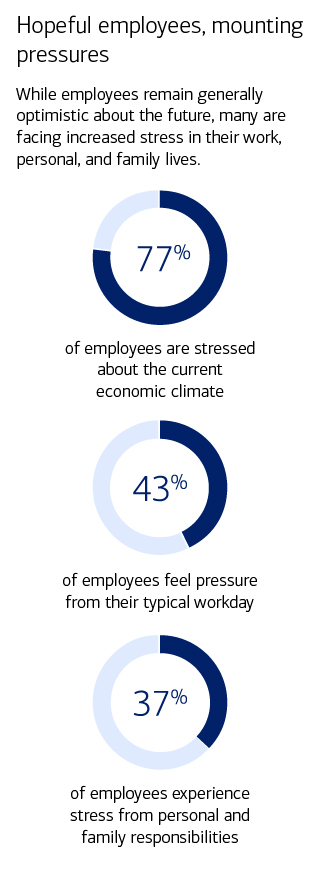
Source: Bank of America 2025 Workplace Benefits Report
Recent data from Bank of America shows:
- 77% of employees feel stressed about the economic climate
- 43% feel workday pressures
- 37% cite personal and family responsibilities as stressors
Thoughtful benefits can help relieve these daily challenges by providing practical support—improving well-being at work and at home.
Supported employees become vocal advocates. At Nerder, after introducing growth stipends and creative retreats, Cameron Prockiw shared, “Our referral hires doubled within a year, and so did client referrals.” He adds, “Employees who feel genuinely supported talk about it openly. That creates authentic advocacy without any extra ad spend.”
Small benefits yield big returns. Cristian-Ovidiu Marin, CEO of FreezeNova, says, “Benefits turned out to be less about perks and more about unlocking the kind of motivation you can’t force any other way.” Enhanced benefits spark creativity and boost productivity.
Happier, more fulfilled employees also build better client relationships. Ray Gettins, Director at United Advisor Group, observes, “Happy employees deliver the kind of thoughtful, personalized service that creates lasting client loyalty.” He links this satisfaction to client retention rates above 95%.
Ask yourself: Are you investing in ways that turn employees into advocates? The right benefits enhance employee satisfaction and fuel brand growth.
The power of prioritizing people
Workplace benefits are a strategic tool, not merely a cost. They increase productivity, decrease expensive turnover, and improve your company’s reputation. Investing in employee happiness is a direct investment in long-term business stability and success.
Now is the time for small businesses to rethink how they support their teams. Design workplace benefits programs that truly put employee well-being first, while achieving business goals. Not only does this create a resilient team, but it also builds a small business able to thrive for years to come.
Connect with a team member today.
Discover how we can empower your employees through powerful tools and personalized guidance.
YFS Magazine is not an affiliate of Bank of America Corporation
1 Gallup, The Q12®: The World’s Leading Employer Engagement Survey
2 Pepperdine Libraries, Organizational success: how the presence of happiness in the workplace affects employee engagement that leads to organizational success
3 Gallup, Employee Retention Depends on Getting Recognition Right
4 American Psychological Association, 2025 Work in America Survey: The Experience of Working in America During Times of Change , July 2025.